Career Change: How to Transition Your CV to a New Industry
Switching careers? Learn how to reframe your experience and create a CV that opens doors in your new field.
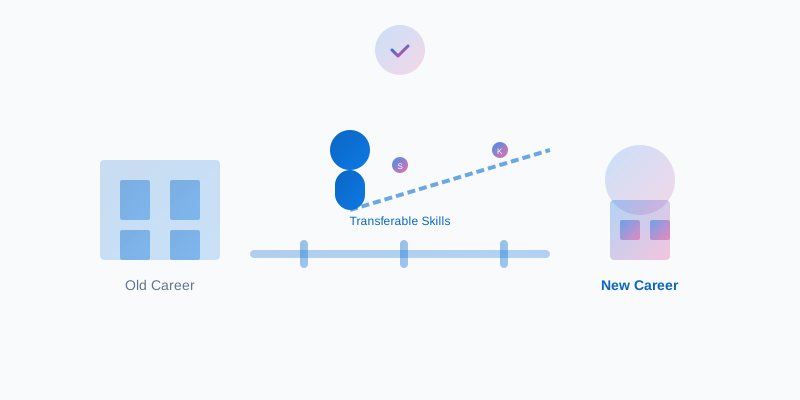
Changing careers is one of the most challenging job search scenarios. You're competing against candidates with direct industry experience, and your CV might not immediately show why you're qualified. But with the right strategy, you can successfully transition to a new field.
The Career Change Challenge
The Problem:
- Your experience is in a different industry
- Recruiters may not see the connection
- You lack industry-specific keywords
- Your achievements seem irrelevant
The Solution: Reframe your experience to highlight transferable skills and demonstrate your value in the new industry's language.
Step 1: Identify Transferable Skills
Before rewriting your CV, identify what skills transfer:
Universal Skills (Apply to Any Industry)
- Communication: Writing, presenting, negotiating
- Leadership: Managing teams, projects, initiatives
- Problem-Solving: Analyzing issues, finding solutions
- Project Management: Planning, organizing, executing
- Data Analysis: Interpreting data, making decisions
- Customer Service: Client relations, support
- Sales: Persuasion, relationship building
- Training: Teaching, mentoring, onboarding
Industry-Specific Transfer
Map your current skills to the new industry:
Example: Teacher → Corporate Trainer
- ✅ Curriculum development → Training program design
- ✅ Classroom management → Facilitation skills
- ✅ Student assessment → Performance evaluation
- ✅ Parent communication → Stakeholder management
Step 2: Reframe Your Experience
Use Industry Language
Learn the terminology of your target industry and use it in your CV:
Before (Education Industry):
"Developed lesson plans for 30 students"
After (Corporate Training):
"Designed and delivered training programs for groups of 30+ participants, achieving 95% satisfaction ratings"
Focus on Outcomes, Not Context
Emphasize what you achieved, not where you achieved it:
Before:
"Managed restaurant operations"
After:
"Led operations for a $2M business, managing 15-person team and improving efficiency by 25%"
Highlight Relevant Projects
Even if your main role was in a different industry, highlight projects that relate to your target field:
Example:
"While working in marketing, developed a Python script to automate data analysis, reducing reporting time by 80%"
This shows programming skills even if your title wasn't "Developer."
Step 3: Restructure Your CV
The Functional/Hybrid Format
For career changers, consider a hybrid CV format:
- Professional Summary (targeted to new industry)
- Core Competencies (transferable skills)
- Relevant Experience (reframed achievements)
- Professional Experience (chronological, condensed)
- Education & Certifications
Professional Summary Example
Career Change: Sales → Product Management
"Results-driven professional with 5+ years in B2B sales, specializing in understanding customer needs and translating them into solutions. Proven track record of managing complex client relationships and driving revenue growth. Transitioning to product management to leverage analytical skills and customer insights in building products that solve real problems."
Key Elements:
- Acknowledges current experience
- Highlights transferable skills
- Shows clear transition intent
- Demonstrates value
Step 4: Bridge the Gap
Address the Career Change Directly
In your cover letter or professional summary, briefly explain your transition:
Example:
"After 5 years in finance, I'm transitioning to software development. I've completed a full-stack bootcamp and built 3 projects using React and Node.js. My finance background gives me unique insight into fintech products."
Show Continuous Learning
Demonstrate you're serious about the transition:
- Certifications: Relevant courses or certifications
- Projects: Side projects in the new field
- Volunteer Work: Experience in the new industry
- Education: Additional training or degrees
Example Section:
Relevant Training & Projects
• Full-Stack Web Development Bootcamp (2024)
• Built e-commerce platform using React and Node.js
• Contributed to open-source project (50+ commits)
• Completed Google UX Design Certificate
Step 5: Network and Get Experience
Build Industry Credibility
Before applying, build experience:
- Freelance/Contract Work: Take on projects in the new field
- Volunteer: Offer skills to non-profits
- Side Projects: Build a portfolio
- Networking: Attend industry events, join communities
- Informational Interviews: Learn from industry professionals
Update Your LinkedIn
- Change headline to reflect transition
- Add projects and certifications
- Connect with people in the new industry
- Share content related to your target field
- Join relevant groups
Common Career Change Scenarios
Scenario 1: Corporate to Startup
Challenge: Corporate experience may seem too formal or slow
Solution:
- Emphasize adaptability and fast-paced achievements
- Highlight innovation and initiative
- Show comfort with ambiguity
Example:
"Led cross-functional initiative in a fast-paced environment, delivering MVP in 6 weeks with limited resources"
Scenario 2: Technical to Non-Technical
Challenge: Technical skills may seem irrelevant
Solution:
- Frame technical skills as problem-solving
- Emphasize communication and translation abilities
- Show business impact of technical work
Example:
"Translated complex technical concepts for non-technical stakeholders, enabling data-driven decision making"
Scenario 3: Non-Technical to Technical
Challenge: Lack of technical experience
Solution:
- Highlight projects and certifications
- Emphasize learning ability
- Show problem-solving from previous roles
- Build a strong portfolio
Red Flags to Avoid
❌ Apologizing for Your Background
Bad:
"Although I don't have direct experience in marketing..."
Good:
"My background in sales provides unique insight into customer behavior and conversion optimization"
❌ Hiding Your Previous Career
Don't try to hide your past. Instead, reframe it as valuable experience.
❌ Being Too Vague
Be specific about what you bring, even if it's from a different context.
The Power of Storytelling
Your career change is a story. Tell it compellingly:
- The Why: Why are you changing? (Show passion, not desperation)
- The What: What are you bringing? (Transferable skills)
- The How: How are you preparing? (Learning, projects, networking)
- The Value: What value do you add? (Unique perspective)
Tools for Career Changers
- ApplyFast: Tailor your CV to show relevance in new industries
- LinkedIn: Network and build industry presence
- Coursera/Udemy: Gain relevant certifications
- Meetup: Attend industry events
- Portfolio Sites: Showcase projects (GitHub, Behance, etc.)
Success Story Framework
Many successful career changers follow this pattern:
- Identify transferable skills (2-3 core competencies)
- Gain relevant experience (projects, freelance, volunteer)
- Build industry knowledge (courses, networking, reading)
- Reframe CV and LinkedIn (use industry language)
- Target entry/mid-level roles (realistic expectations)
- Leverage unique background (different perspective = value)
Action Plan
- ✅ List all transferable skills
- ✅ Research target industry terminology
- ✅ Identify 3-5 relevant projects/experiences
- ✅ Rewrite professional summary
- ✅ Reframe 5-7 key achievements
- ✅ Update LinkedIn profile
- ✅ Build portfolio/projects
- ✅ Network with industry professionals
- ✅ Get feedback on your CV
- ✅ Start applying with confidence
Conclusion
Career changes are challenging but entirely possible. The key is reframing your experience to show value in the new industry's language. Your previous career isn't a liability—it's a unique advantage that sets you apart.
Remember: Every skill you've developed is transferable. You just need to present it in a way that resonates with your target industry.
Ready to make your career change? Use ApplyFast to tailor your CV and show recruiters why your unique background is exactly what they need.
More Articles
5 Essential CV Tips for 2025
Stay ahead of the competition with these proven CV strategies that work in today's job market.
January 5, 2025
How to Tailor Your CV for Each Job Application
Learn the art of CV customization and why tailoring your resume to each job description dramatically increases your chances of getting noticed.
January 15, 2025